Friday, 21 April 2023

The Ostein Landscape Garden - an early example of romantic gardens.

The park is located north of the Rhine River on a hilltop with impressive views of the Rhine bend near Bingen. It is largely a former hunting area with timber exploitation. The trees were repeatedly shortened and sprouted again. This leads to low trees with sparse growth. In between the lower berms, however, there are always tall old oaks.


The name of the park can be traced back to its initaor Johann Friedrich Karl Maximilian von Ostein. In 1764 the construction of a hunting lodge on a ridge was started and the surrounding forest was developed as a hunting ground. A remnant of this is a gate with fallow deer next to the castle.

Already ten years after the construction of the castle, the count began to transform the surrounding forest. Wooden buildings were erected which, although serving as a symbol of seclusion, soon became a destination for excursions. At the end of the eighteenth century, stone buildings in an romantic style followed - artificial castle ruins (Rossel castle ruin), a temple with a view of the Rhine valley or a knight's hall, of which only the foundation walls are preserved today. A half-terrestrial magic cave (as a 60 m long corridor) with a magic hut fits well into the romantic concept. Originally, the park was accessible only to the count and his guests. With the count's death, many buildings fell into disrepair. Today, the grounds have been restored or rebuilt after war damage. As part of the World Heritage Middle Rhine Valley, the park is well accessible. From the neighboring wine villages of Rüdesheim and Assmannshausen, cable cars lead from the valley up to the mountain ridge. Part of the park today is also the Niederwald Monument, built from 1871 to 1883 to commemorate the founding of the German Empire in 1871. The 38-high statue of Germania there looks out over the vineyards and the Rhine, visible from afar.

During the meeting in Babenhausen we had the chance to visit the place with our guests.


Invasive species in the salt marshes of Playa de Matorral on Fuerteventura

The salt marshes in the tourist resort of Jandia in the south of the island of Fuerteventura are the only wetland of international importance on the Canary Islands. Strictly protected from human use, they are nevertheless in danger - but from invasive species. Such species originate from other parts of the world and are called neophytes (in the case of plants) or neozoa (in the case of animals). Since they can spread in the new habitat without their traditional enemies and competitors, they sometimes have a considerable impact on local ecosystems.

For Playa de Matorral, two species will be presented in more detail below.

A North American plant (of the plant family Faboideae) was probably introduced from Mexico for horticultural purposes on Gran Canaria and Fuerteventura. The species Desmanthus permanbucanus (Pigeon bundleflower) is considered to be a proliferating weed. The Faboideae plants are able to accumulate nitrogen as nitrate in the soil through nodule bacteria in the roots. In agriculture, they are therefore planted as a green fertiliser. In natural habitats, however, this causes a strong change in soil chemistry and is a threat to plants adapted to nutrient-poor soils. This has an effect, for example, in the barrancos, the erosion gullies in volcanic deposits on the island. For more information, see Verloove, F. & Borges, L. M., 2018: On the identity and status of Desmanthus (Leguminosae, Mimosoid clade) in Macaronesia, Collectanea Botanica 37 (https/doi.org/10.3989/collectbot2018.v37.007).

Desmanthus permanbucanus produces a large quantity of small seeds that accumulate in the soil as a seed reservoir and germinate when conditions are favourable. With this dispersal strategy it is difficult to control, as seeds are always left behind that can germinate later. The plant is controlled by pulling out seedlings before they can form seeds themselves or by using plastic sheeting in areas containing seeds.

Either opaque plastic is used to keep the moisture in the soil under the sheeting. The plants that germinate then perish due to the lack of light. With transparent plastic film, germination is accelerated. This makes it easy to observe the growth and the seedlings are then removed.


The ubiquitous North African bristled squirrels (Atlantoxerus getulus) are very popular among tourists. Although there are signs in many places urging people not to feed the animals, many people do not comply. Sometimes they even feed right next to prohibition signs. The Atlas squirrels were brought to the island of Fuerteventura as pets in 1965 and were able to spread almost everywhere due to the lack of natural enemies. Only in hotel complexes with cats no squirrels are found.

They are considered pests for the island's agriculture and a threat to native plants and animals. They compete for food with the native Eastern Canary Island lizard (Gallotia atlantica) or cause changes in the composition of plant communities. For example, they support the spread of prickly pears, which are also not native to the Canary Islands. Their juicy fruits are readily eaten by the squirrels on the very dry island. The aim is to prevent the squirrels from spreading to other islands (e.g. through ferry traffic). First settlement attempts on Gran Canaria or Lanzarote were probably successfully stopped.

Nature conservation in a holiday area – the Playa de Matorral on Fuerteventura

Since the 1960s, Fuerteventura, the second largest of the Canary Islands, has developed into an important tourist destination. Especially the south of the island around the former fishing village of Morro Jable on the Jandia peninsula is a hotspot of tourism on the island. Apart from a narrow coastal strip around Morro Jable, almost the entire peninsula has been protected as the Jandía Natural Park (Parque Natural de Jandía) since 1987. Since the development of tourism began in the mid-1960s with the Casa Atlántica hotel in Jandia Playa on the south coast, nature conservation and tourism have had to be reconciled. This applies in particular to the coastal salt marshes between the hotel zone and the actual sandy beach. The beach itself counts as a special zone with restricted use, which, however, means practically no restrictions for tourists. There are plenty of beach bars, deck chairs and surfing facilities on the wide sandy beach. 

Between the beach and the Jandia coastal motorway (and the hotel behind) lies the Matorral - a 115.6-hectare salt marsh. It is the only wetland in the Canaries to be included in the list of wetlands of international importance (RAMSAR Convention). Such coastal salt marshes are rare in the Canary Islands. The Matorral is also home to some endemic invertebrates and reptiles. Endemic species are those that only exist in a certain geographical area, for example only on a certain island or group of islands.

The low vegetation is characterised by salt-loving plants (halophytes) that withstand the high salinity of the soil through occasional flooding. These occur mainly during spring and autumn as spring tides around the equinoxes. Typical of the area are seabirds and waders for which the wetland is an important stopover in bird migration. A detailed description of the plant and animal species living there can be found in Spanish here: https://rsis.ramsar.org/RISapp/files/RISrep/ES1262RIS.pdf.

Access is strictly prohibited and the area is secured by a wooden fence. No human use occurs on the site. A wooden boardwalk leads from the main road across the salt marshes to the strand and ends at the lighthouse, which is visible from afar and counts as the landmark of Jandia. Signs not only point out the ban to enter the marsh, but also explain the importance of the Matorral as a wetland. For tourists, this may mean small diversions to the beach, as there are only two crossings on the almost three kilometres of extension along the shore. Nevertheless, nature conservation and tourism seem to harmonise well at this point.


Monday, 20 March 2023

The meeting in Buncrana

The meeting in Buncrana comprised a plethora of well-organised activities linked to the GREEN-project itself but also to the overarching goal of fostering intercultural competence and knowledge among the young Europeans inherent in all ERASMUS activities – referred to by the hosts as “the spirit of ERASMUS”.

Regarding its content, the activity touched upon a variety of subjects – due to the multidisciplinary nature of the GREEN project. In more detail, specific topics such as the local flora and fauna represented in wildlife habitats and their preservation (e.g. in national parks and sanctuaries), cultural and historical aspects of human involvement with nature (e.g. peat cutting and invasive plants, creation of parks) as well as the geological formation and human-led deformation of landscapes (e.g. coastal erosion, fishing) represented the basic thematic building blocks for the students. Apart from these specific topics linked to the project, of course, local culture, traditions, and history also played a large role in the student’s involvement with the host country. Particularly the North Ireland conflict whose deep ramifications and brutal repercussions could still be felt in many ways did not leave the students and the visiting teachers untouched. 


Methodologically, internet-based research, interviews, varying group activities, presentations, guided tours, written tasks and manual work were interwoven in a multi-methodological and multi-sensorial experience for the students. The methodology changed and depended on the particular activity carried out on each day (see below in the description).

The various findings and results were documented in multiple physical and non-physical forms, ranging from handmade-products (e.g. recycled shirts, local food), written pieces (the blog, essays, flyers, comments) and various presentations and group talks.

The activity both evolved around and exceeded the “normal activities” of the hosting college, depending on the day and focus. While some activities, as described above, followed the local school timetable and also included participation in regular classes and a lunch in the school canteen, others – for the obvious reason of being extra-curricular trips and activities - went beyond the regular school activities. This was all due to the special character of an ERASMUS-meeting which naturally includes more extra-school activities than a regular school day.

On March 10th the activity kicked off with a variety of tasks and games aimed at breaking the ice between students and getting to know Irish culture a little better. The host had prepared a large variety of group activities and games of skill in which the five different groups had to actively engage with the partners from the different countries in order to find solutions for various riddles and games. This was greatly enjoyed and served its ice-breaking-purpose very effectively, as well as the fantastic Irish Culture showcase of traditional dancing and music which left a deep impression on students and teachers alike. After a tour around school focussing on environmental and ecological aspects a treasure hunt around Buncrana was carried out in which students had to work on tasks related to the GREEN-Project and upload their findings to a cloud for sharing. For example they had to identify certain plants or ecological habitats and along the way they got to know the town of  Buncarana. 

On the next day a trip to Malin Head enabled the students to learn about the very special coastal landscape and its ecological importance. The tour guide spoke about the historical importance of turf for the region and its now acknowledged ecological meaning as a natural storage for carbon dioxide, as well as the wildlife and the threat of coastal erosion for the region. A guided tour with lamas showed  the students how  ecological and sustainable tourism could be carried out. The day was finished off with a trip to Derry focusing on historical aspects such as the troubles and the conflict between Ireland and Northern Ireland. 

Monday 13th March brought us to Glenveagh National Park where the students had to solve different tasks with the help of the rangers who led them through the park and explained about its peculiarities and ecological importance. On Tuesday 14th  a carousel of activites was carried out in Buncrana College focussing on GREEN aspects. These reached from baking activities using local and sustainable ingredients to woodwork and recycling activities. All activities were carried out in mixed groups and included presentations and group talks. After a packed day in school, a tour to a wildlife sanctuary (Wild Ireland) was carried out where the students learned about the importance of the local fauna and the attempts to resettle certain species in this region of Ireland.

Monday, 19 December 2022

The mobility to Lisbon

The Lisbon project meeting purpose was to explore different green places, from Natural Parks to small gardens, activate knowledge, reflect together and come to conclusions about how we can find the right balance between man and nature and protect and restore our environment.


The activities planned for the meeting included multinational teams of teachers and students from the different countries involved promoting collaborative work among everyone. Each team divided tasks, took notes, used new technologies, creativity and skills to give their contribution to the project. 

Collelcting seeds at Bela Vista Park

The first day started at school with a welcome moment with ice-breaking activities to welcome and strengthen the bonds of friendship and exchange of experiences. A guided tour to the school was carried out and later the students and teachers were led through the School Open Day Activities that were taking place, on the topic Water. Then, the group went for a walk to Bela Vista Garden to collect different seeds of natural species. It was also an opportunity to walk around, sharing with nature and enjoying the view over Lisbon. 


The wetlands of EVOA - Tagus estuary

The second day was a Day Trip to the Tagus Estuary Natural Reserve, EVOA – Tagus Estuary Birdwatching and Conservation Area, which allowed the group to know and enjoy the unique heritage between the Lezíra and the Tagus Estuary. There, students and teachers got to know the permanent exhibition – EVOA, Where the World Meets the Tagus – and participated in the different activities that are complementary to birdwatching, as for example the recognition of the contrast between landscapes, the relation between tradition and innovation and the variety of species that feed and take refuge in the canals, in the agricultural fields and in the Lezíria’s pasture lands. There, it was possible to develop activities that reflect the relation between man and nature in order to keep a balanced sustainability. On the third day, students spent their time with the host families and host students, and it was time for cultural sharing. 

Gulbenkian Park

On the fourth day, the group had a guided tour through Calouste Gulbenkian Garden, one of the most emblematic gardens of the Portuguese modern movement and a guided walk through The Green Corridor project of Monsanto, designed over three decades, and it was possible to get acquainted with two ciclopedonais gardens, horticultural Park pasturelands, cornfields, viewpoints and parks for physical maintenance.

Olivais Pedagogical Farm


In the last day, students reflected and shared ideas about nature, in groups. Reflections were made in the mother tongue and then shared in English. A group of students from the Multimedia Professional Course was recording and reporting on the entire activity for later sharing. Then, the group visited Olivais Pedagogical Farm. In addition to discovering the variety of animals that live there, the group participate in a composting and planting activity. The Lisbon meeting ended with sharing moments in a Farewell party.


Street art nade of plastic garbage


Tuesday, 6 December 2022

Lisbon Report

 Friday 2

Our second day and first one at school, started with some break ice activities and a tour at the school, where we could meet the other students and have a lot of fun.

Then they explained and showed us one project that all Portuguese schools are doing now called DAC that is about water.

After this school activities we had lunch at the canteen and went to a beautiful park called Bela Vista Garden, when they explained us the nature that was there and collected some seeds, we also had a break and saw the Portugal match. 

Finally, we visited a little part of the center of Lisbon and had dinner all together.

Marta Becerra


Saturday 3


Today, Saturday, we have spent our time visiting a special place. We had to move to Vila Franca de Xira to enjoy of a huge habitat characterized by having some special conditions which allow animals to live in a perfect ecosystem. Also in there, they are studied and classified by scientists just for them to be controlled and protected. We have acted like ones by observing different types of animals and knowing even the deepest curiosities we could imagine. The explanations and activities were interesting, that's why we felt very glad to discover all that information about animals, concretly birds. The conclusion of this journey is the fact that people cause a rellevant impact on other human beings and we have to be aware of caring our home and the ones we share it to. On the way back, we crossed the bridge Vasco da Gama, which is 14 km long....

Ingrid Fernández


Sunday 4 

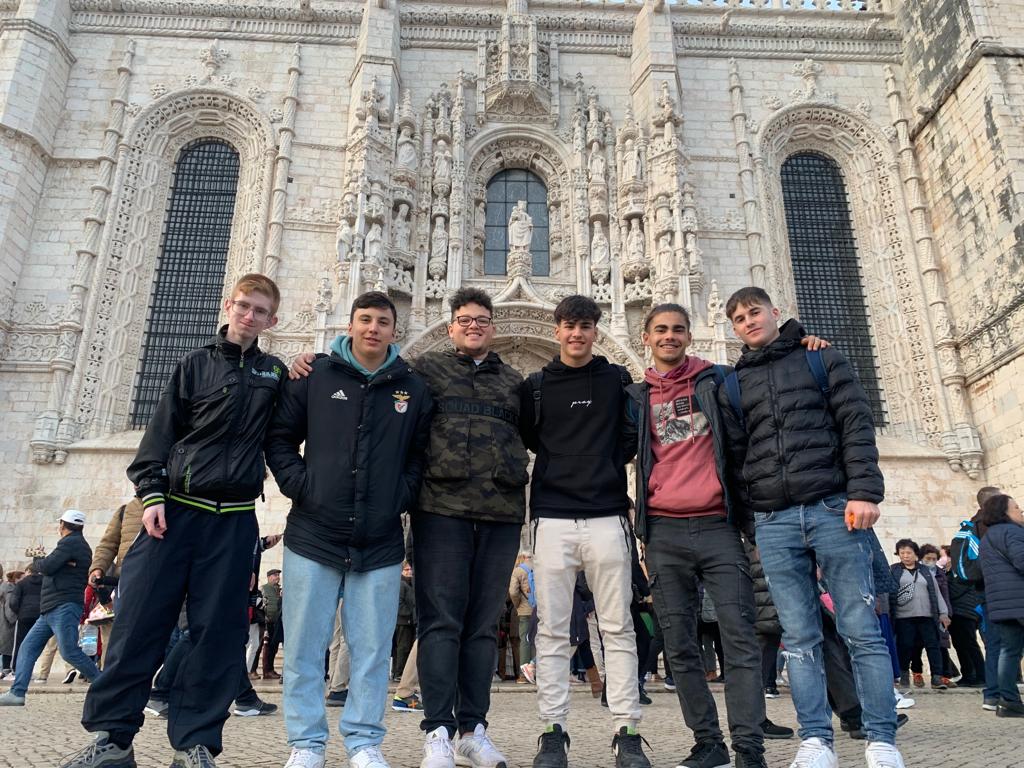
Sunday: Today some of us went to the Benfica stadium in the morning. Later, in the afternoon we went to the factory where they make Pastel de Belém. They were very good and we took the opportunity to buy some for our family. Afterwards we walked along a riverside promenade and saw some important monuments...

Gerard Oller


Monday 5

Today we started our day at the school, when we had all arrived, we took the metro to San Sebastio station, where we walked five minutes and arrived at 'Calouste Gulbenkian Garden'.

In this place we saw beautiful and different exhibitions and an amazing garden that a guide explained to us.
After 2 hours visiting the place, we had lunch.

When we finished to eat, we walked 30 minutes to arrive at 'The Green Corridor project of Monsanto' where we were able walk trough the nature and observe the city of Lisbon.

After doing these activities students and teachers separated ourselves, and the students  went to the Christmas market of 'Wonderland' where we spent a short time because after that, we had a reservation in a Chinese restaurant with a big buffet, where we stayed for such long time I and we had a lot of fun.