Showing posts with label Project. Show all posts

Tuesday, 18 July 2023

Environmental learning and comunity service symposium

On July 2022 Manyanet Sant Andreu  was selected to join a symposium about environmental learning and comunity service activities organized by XESC (Xarxa d'escoles per la sostenibilitat de Catalunya-Network of Schools for the Sustainability of Catalonia). 

Conxita Payán, one of the Spanish teachers involved in the Erasmus exchange program  showed to other teachers from all Catalonia a presentation about our project making insect hotels as part of our Erasmus+ project.

Symposium link: http://escolesxesc.cat/ii-simposi-espai-agora/


Wednesday, 7 June 2023

Our meeting in Thessaloniki

Dear friend of our blog - you want to know something about our recent meeting in Thessaloniki? Check out thie e-book. https://www.storyjumper.com/book/read/158901591/647a2d76dfb26

Tuesday, 30 May 2023

Spreading the results and our ideas

On Monday, May 29, the programs -Environmental, two E-Twinning and two ERASMUS + implemented by our school (3rd Gymnasio Evosmou) were presented in our school community. Students and teachers shared and presented their ideas and their achievements. At the same time, sports events took place in our schoolyard. Our entire school community celebrated the results of their efforts. Many congratulations to all! Some photos of the event on the link below


https://www.fotor.com/share/e19b7757-34d6-4d3f-ba66-fdbe7dc8b6b2


E-book about the dissemination event in Thessaloniki

 You want to have a closer look? Here's an e-book about our dissemination event recently:

https://read.bookcreator.com/KDys4T0MfvgGneA6nmhC9JyliZk2/HQ4fFEsAQy2EiZKdEXK26Q

Monday, 20 March 2023

The meeting in Buncrana

The meeting in Buncrana comprised a plethora of well-organised activities linked to the GREEN-project itself but also to the overarching goal of fostering intercultural competence and knowledge among the young Europeans inherent in all ERASMUS activities – referred to by the hosts as “the spirit of ERASMUS”.

Regarding its content, the activity touched upon a variety of subjects – due to the multidisciplinary nature of the GREEN project. In more detail, specific topics such as the local flora and fauna represented in wildlife habitats and their preservation (e.g. in national parks and sanctuaries), cultural and historical aspects of human involvement with nature (e.g. peat cutting and invasive plants, creation of parks) as well as the geological formation and human-led deformation of landscapes (e.g. coastal erosion, fishing) represented the basic thematic building blocks for the students. Apart from these specific topics linked to the project, of course, local culture, traditions, and history also played a large role in the student’s involvement with the host country. Particularly the North Ireland conflict whose deep ramifications and brutal repercussions could still be felt in many ways did not leave the students and the visiting teachers untouched. 


Methodologically, internet-based research, interviews, varying group activities, presentations, guided tours, written tasks and manual work were interwoven in a multi-methodological and multi-sensorial experience for the students. The methodology changed and depended on the particular activity carried out on each day (see below in the description).

The various findings and results were documented in multiple physical and non-physical forms, ranging from handmade-products (e.g. recycled shirts, local food), written pieces (the blog, essays, flyers, comments) and various presentations and group talks.

The activity both evolved around and exceeded the “normal activities” of the hosting college, depending on the day and focus. While some activities, as described above, followed the local school timetable and also included participation in regular classes and a lunch in the school canteen, others – for the obvious reason of being extra-curricular trips and activities - went beyond the regular school activities. This was all due to the special character of an ERASMUS-meeting which naturally includes more extra-school activities than a regular school day.

On March 10th the activity kicked off with a variety of tasks and games aimed at breaking the ice between students and getting to know Irish culture a little better. The host had prepared a large variety of group activities and games of skill in which the five different groups had to actively engage with the partners from the different countries in order to find solutions for various riddles and games. This was greatly enjoyed and served its ice-breaking-purpose very effectively, as well as the fantastic Irish Culture showcase of traditional dancing and music which left a deep impression on students and teachers alike. After a tour around school focussing on environmental and ecological aspects a treasure hunt around Buncrana was carried out in which students had to work on tasks related to the GREEN-Project and upload their findings to a cloud for sharing. For example they had to identify certain plants or ecological habitats and along the way they got to know the town of  Buncarana. 

On the next day a trip to Malin Head enabled the students to learn about the very special coastal landscape and its ecological importance. The tour guide spoke about the historical importance of turf for the region and its now acknowledged ecological meaning as a natural storage for carbon dioxide, as well as the wildlife and the threat of coastal erosion for the region. A guided tour with lamas showed  the students how  ecological and sustainable tourism could be carried out. The day was finished off with a trip to Derry focusing on historical aspects such as the troubles and the conflict between Ireland and Northern Ireland. 

Monday 13th March brought us to Glenveagh National Park where the students had to solve different tasks with the help of the rangers who led them through the park and explained about its peculiarities and ecological importance. On Tuesday 14th  a carousel of activites was carried out in Buncrana College focussing on GREEN aspects. These reached from baking activities using local and sustainable ingredients to woodwork and recycling activities. All activities were carried out in mixed groups and included presentations and group talks. After a packed day in school, a tour to a wildlife sanctuary (Wild Ireland) was carried out where the students learned about the importance of the local fauna and the attempts to resettle certain species in this region of Ireland.

Monday, 19 December 2022

The mobility to Lisbon

The Lisbon project meeting purpose was to explore different green places, from Natural Parks to small gardens, activate knowledge, reflect together and come to conclusions about how we can find the right balance between man and nature and protect and restore our environment.


The activities planned for the meeting included multinational teams of teachers and students from the different countries involved promoting collaborative work among everyone. Each team divided tasks, took notes, used new technologies, creativity and skills to give their contribution to the project. 

Collelcting seeds at Bela Vista Park

The first day started at school with a welcome moment with ice-breaking activities to welcome and strengthen the bonds of friendship and exchange of experiences. A guided tour to the school was carried out and later the students and teachers were led through the School Open Day Activities that were taking place, on the topic Water. Then, the group went for a walk to Bela Vista Garden to collect different seeds of natural species. It was also an opportunity to walk around, sharing with nature and enjoying the view over Lisbon. 


The wetlands of EVOA - Tagus estuary

The second day was a Day Trip to the Tagus Estuary Natural Reserve, EVOA – Tagus Estuary Birdwatching and Conservation Area, which allowed the group to know and enjoy the unique heritage between the Lezíra and the Tagus Estuary. There, students and teachers got to know the permanent exhibition – EVOA, Where the World Meets the Tagus – and participated in the different activities that are complementary to birdwatching, as for example the recognition of the contrast between landscapes, the relation between tradition and innovation and the variety of species that feed and take refuge in the canals, in the agricultural fields and in the Lezíria’s pasture lands. There, it was possible to develop activities that reflect the relation between man and nature in order to keep a balanced sustainability. On the third day, students spent their time with the host families and host students, and it was time for cultural sharing. 

Gulbenkian Park

On the fourth day, the group had a guided tour through Calouste Gulbenkian Garden, one of the most emblematic gardens of the Portuguese modern movement and a guided walk through The Green Corridor project of Monsanto, designed over three decades, and it was possible to get acquainted with two ciclopedonais gardens, horticultural Park pasturelands, cornfields, viewpoints and parks for physical maintenance.

Olivais Pedagogical Farm


In the last day, students reflected and shared ideas about nature, in groups. Reflections were made in the mother tongue and then shared in English. A group of students from the Multimedia Professional Course was recording and reporting on the entire activity for later sharing. Then, the group visited Olivais Pedagogical Farm. In addition to discovering the variety of animals that live there, the group participate in a composting and planting activity. The Lisbon meeting ended with sharing moments in a Farewell party.


Street art nade of plastic garbage


Monday, 30 May 2022

The first meeting - our mobility to Barcelona

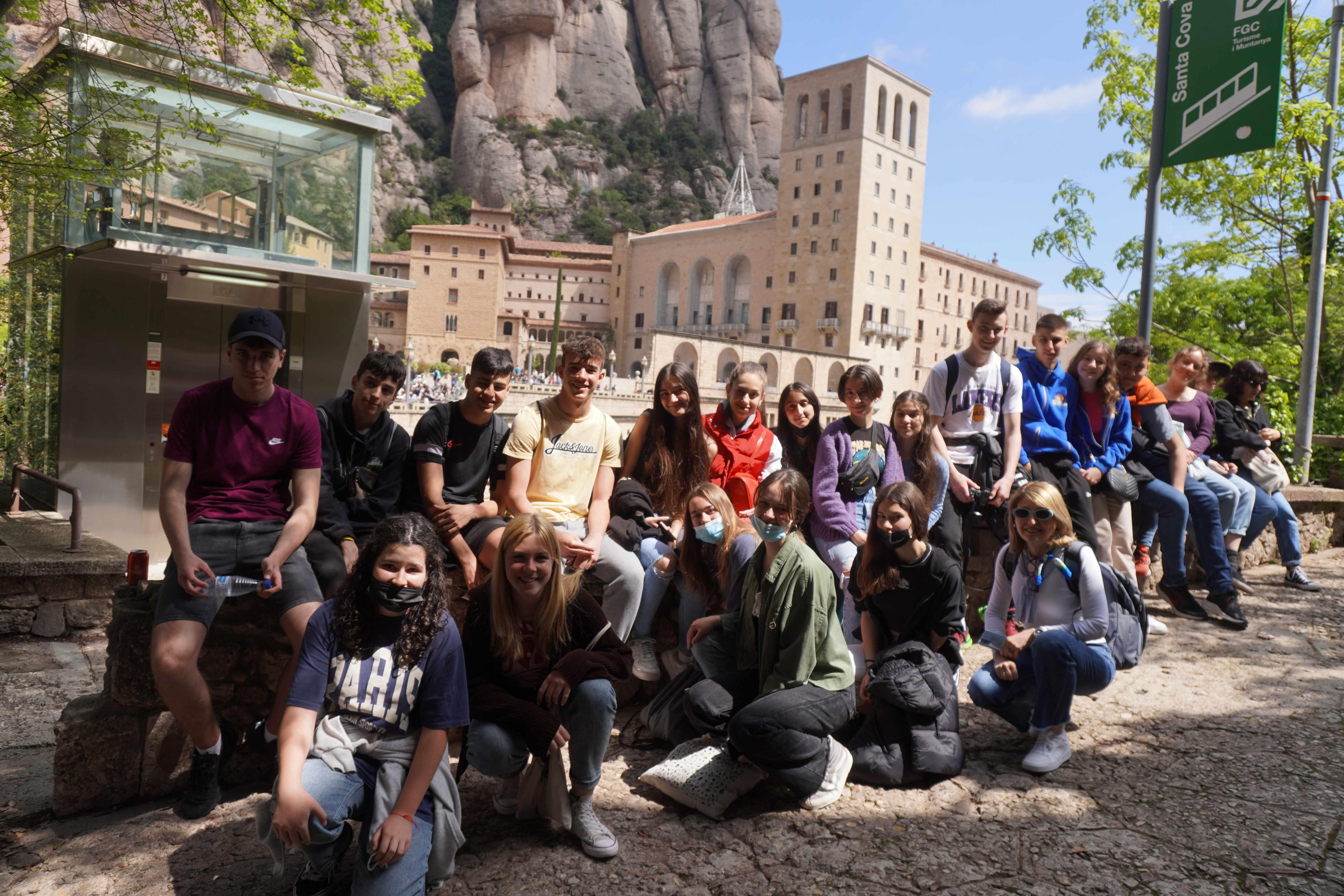
The meeting started with a visit to Monserrat with all the teams to get to know each other and visit an cultural and environmental important place for the region. The day after, a Monday, contained a school tour and a welcome by the school’s principal. The afternoon brought all the students to Sagrada familia cathedral which is obviously a must visit during a stay in Barcelona. We finished the day with the creation of T-Shirt, which had been painted at school with the participants. Tuesday was used to finish the building of the insect hotels which were delivered to local parks later that day. Group also investigated the history of parks around and the afternoon closed with a Barelona City Centre tour. On Wednesday all the group visited the botanical gardens of Matrimurta and enjoyed a day trip to Blanes with some free time at the beach. The final day was mainly used for presentations at school finishing off the project work. Afternoon was used for a guided visit to Parque Guell and the day closed with a goodbye pizza party near school!


The weekly activities adhered to the structure of the school day in Spain every morning from Monday to Thursday except for the day trip to the beach on Wednesday. Students carried out the tasks in the classroom and took breaks at the same time as the normal Spanish students and ate lunch in the canteen every day with the other students also.

There were many cross curricular links to subjects that the students follow in their own countries.  The T shirt designing was taught to the students by an Art and Design teacher.  The Insect hotel creation was an amazing project, which the Spanish students had been preparing in advance of the mobility for 6 months to enable the actual final product to be delivered to local parks that week. At the same time all students felt ownership of the work as the final touches were made in the technology department on the Wednesday session. A local expert in parks from the council helped the students with the design and the final outcome was excellent. Students had a real sense of satisfaction as they wheeled the beautiful construction out to the local council member for park in the nearest park to the school.  They also delivered another insect hotel to a local allotment at a residential centre for the elderly- the new generation was aiding the elder generation to pollinate their vegetable gardens. What a beautiful concept!

The subject of Geography was the most important subject studied by the participants as the project work every day was discussing local parks and their changing history.  The visit to the Marimurtre Gardens on Wednesday was a fascinating experience where one of the scientists from the outdoor lab at the centre described the evolution of the plants to fit into their local habitat and we looked at the variety of plants from across the the World that the German creator had gathered at the turn of the last century and brought to this special place with it’s individual microclimate. The biodiversity and botanical science learning experience here was excellent.

Handing over the bug hotel to Pergaso park
I’ve mentioned above how each daily activity was carried out at the school and how each subject was touched upon and how students got to see a day in the life of a Spanish student by following the normal timetable.  The in-school activities were usually student led- each group had to present their findings to the others and they were in mixed groups to enable them to work together with students from different countries. The first presentations were in individual countries as they were introducing themselves and their schools, and by the end of the week the students were in mixed groups presenting their findings from the survey that had been completed in each country prior to the mobility or their poster presentations on the history of local parks in each country.  

The afternoon activities were based on discovery of the cultural aspects of Barcelona. We had a brilliant day in Montserrat seeing the amazing views from the abbey and climbing the path towards the cross. The Parque Guell was a brilliant tour describing the genius in Gaudi’s architecture- the GREEN aspects of the design of the chairs with the tubes guiding water down to water the lower gardens  and the ergonomic nature of the tiled seating around the viewing platform were very interesting!


Tuesday, 21 December 2021

Erasmus week report by Helena Reboll

We, students from Barcelona, started our new Erasmus project and this is what  we did

last week: Our project is related to preserving our environment and taking care of the natural

life  surrounding us. We were proposed to build a bug hotel and we accepted the challenge

right away. For those who don’t know, an insect or bug hotel is a structure built with wood

and used the bugs to rest and to lay its eggs.


The materials were given to us and we started constructing. First, we drew a sketch of our

structure and measured everything. Once we had all sized up and put together, we started

attaching all the pieces together with screws and glue. Our hotel was three floors in total so

we had a long way to go! Then, after finally constructing our structure, it was time to

decorate it and to varnish it. Some of us drew insects and plants, others painted clouds and

suns.  They turned out really nice! We had to put two layers of varnish and wait for them to

dry up. When everything was  done we started putting inside the hotel some materials to

make it more comfortable for bugs. Once the bug hotels are completed we will put them

on a urban orchad and a park from our neighbourhood.


Aside from all of this work, some students did the “Erasmus Corner”. This was basically

a poster to hang in the hallways explaining the process of this project. We also wrote some

 information  about the other schools from all over Europe that participate in this project.

This was very fun  and it ended up being really big and colorful!!!