After an online poll we have a logo for the project, this one:

Below, you also have the poll results and the other logo candidates:


After an online poll we have a logo for the project, this one:
We,
students from Barcelona, started our new Erasmus project and this is what we did
last
week: Our project is related to preserving our environment and taking care of
the natural
life surrounding us. We were proposed to build a
bug hotel and we accepted the challenge
right
away. For those who don’t know, an insect or bug hotel is a structure built
with wood
and
used the bugs to rest and to lay its eggs.
The
materials were given to us and we started constructing. First, we drew a sketch
of our
structure
and measured everything. Once we had all sized up and put together, we started
attaching
all the pieces together with screws and glue. Our hotel was three floors in
total so
we
had a long way to go! Then, after finally constructing our structure, it was
time to
decorate
it and to varnish it. Some of us drew insects and plants, others painted clouds
and
suns. They turned out really nice! We had to put
two layers of varnish and wait for them to
dry
up. When everything was done we started
putting inside the hotel some materials to
make
it more comfortable for bugs. Once the bug hotels are completed we will put
them
on
a urban orchad and a park from our neighbourhood.


Aside
from all of this work, some students did the “Erasmus Corner”. This was
basically
a
poster to hang in the hallways explaining the process of this project. We also
wrote some
information
about the other schools from all over Europe that participate in this
project.
This
was very fun and it ended up being
really big and colorful!!!
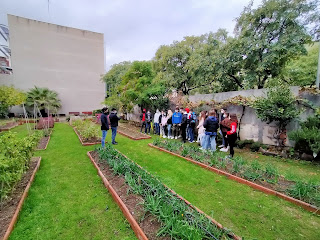
This week Spanish Erasmus+ team visited the urban orchad La Ferroviària. Run by the local neighbours association la Ferroviaria offers students from local schools a unique opportunity to know how are the conditions in which different edible vegetable grow.
In this visit our students researched the best place to install a insect hotel, a shelter for these animals we are going to build at the school as a part of service-learning project.



Today we organised our first online meeting among students and teachers. This way students are getting to know one another in the different meetings we are organising online.


In Hesse Cider (Apfelwein) is a very popular drink and
it is also locally made.
Where did it
come from and how did it come into being?
In the meantime cider is 2500 years old. The Celts
spread it, and it was officially mentioned for the first time in a document by
Emperor Charlemagne. Between the 15th and 16th centuries viticulture was
restricted or completely forbidden due to various problems (pests, climate,
etc.). Due to the fact that apples were not only cheaper but also easier to
grow at that time, they were grown instead of grapes in order to produce the
popular apple wine.

How is it
produced?
Cider is traditionally a pure natural product. During production,
the apples are first crushed and then juiced in a press. The freshly pressed
apple juice flows into a stainless steel tank. In this tank, so-called
"fermentation processes" take place, whereby the sugar contained is
broken down by the fruit's own or added yeast. Alcohol and carbon dioxide are
produced within 10 days. Since the large quantities of carbon dioxide can lead
to unconsciousness and ultimately to death, there must be constant ventilation
of the production rooms.
The longer the cider rests on the yeast, the more
aromatic its taste becomes. The remaining apple residues are used as animal
feed.
In order to make cider keep longer when cooled, it is
heated to 82° to 90°C for 15 to 150 seconds in a plate heat exchanger and thus
pasteurised.
General
information:
-
5-6 vol. % Alcohol
-
The quality of cider depends on the
quality of the apple.
-
Apples mostly come from local
orchards.
-
You can drink it pure, or mixed
(sprayed) with water (=sour) or with Lemonade (=sweet).
-
Typical are also the glasses with the
diamond-shaped pattern and large clay jugs (Bembel) in which the cider is
served.
Orchard meadows are considered a valuable biotope and they
are an old form of fruit growing. In addition to the growth of urban structures
and the development of modern orchards with low-trunk varieties in monoculture,
today's orchard meadows are rather relicts of a formerly more widespread form
of use.
Typical for orchard meadows are tall fruit trees,
mostly of different varieties and ages, scattered over a grassy area. This
allowed a dual use, in that the orchard meadow could additionally be used for hay production or as pasture.

Large-scale fruit cultivation outside settlement areas
such as villages only gained importance during absolutism (17th and 18th
centuries) and expanded significantly from 1800 onwards with the abandonment of
vineyards in the wake of the Little Ice Age. Through breeding, over 6000
different varieties of the main species apple, pear, plum / damson and cherry
were created in the course of time. In more sheltered locations, sweet chestnut
and walnut are also common. All these fruit varieties were introduced to
Central Europe by the Romans. In the Rhine-Main region, the orchard meadows
have had an impact on beverage culture. The national drink of southern Hesse,
"apple wine” (a kind of cider), is a consequence of the change from
viticulture to apple cultivation in the course of the climate cooling in the
19th century.
Since the Second World War, the area and quality of orchard
meadows has declined significantly. The remaining meadows are also poorer in
trees and many tree stands are poorly maintained and overaged. Many of the
traditional, more robust and low-maintenance fruit varieties are rare today, as
they play no role in plantation fruit growing. The reasons for this are a
change in the agricultural policy of the European Union, the higher labour
requirements for harvesting and the growth of the cities. The remaining meadow
orchards are of great importance due to their high biodiversity and as a gene
pool reserve for fruit varieties.

The regionally most important orchard meadow
"Berger Hang" is located east of Frankfurt on the "Berger
Rücken", a ridge north of the Main. This hill was formed when the river Main
burrowed into older (Tertiary) deposits during the Ice Age (Pleistocene). The
slope between Frankfurt and Hanau faces south and forms the northern edge of
the river valley.
The old fruit tree population near Bischofsheim forms
the largest contiguous orchard meadow area in Hessen. It has only been used for
fruit growing since about 1910. Originally it was pasture land, which was later
also used for viticulture. Extensive
orchard meadows and ecologically valuable dry grasslands have survived in a
10-hectare core area. Since 1954, the Berger Hang has been protected from
destruction as a nature reserve.

Even Babenhausen has smaller orchard meadows. Only a
few minutes' walk from the school, in the direction of the railway station,
there is a small stand of fruit trees which is maintained by the Babenhausen
branch of NABU (a nature conservation association). The fruit trees have to be
looked after - for example by pruning the branches and mowing is also necessary
so that the area does not become overgrown with bushes.
Many of the orchard meadow areas are leased out - even
if you can't tell by looking at the unfenced areas. Since fruit is also stolen
by passers-by time and again, managed trees are now often marked with yellow
warning tapes that say "I harvest myself!